
Is SEO Dead in 2026? What the Data Actually Says
Every year someone declares SEO dead. In 2026, the argument sounds more convincing than usual: 68% of U.S. Google searches now end without a single click, AI Overviews frequently occupy prime search real estate, and tools like ChatGPT and Perplexity are answering queries directly. Through hands-on SEO practice, PinoySEO Bootcamp training, and building real implementations like schema entity graphs, technical audits, and a GBP diagnostic tool, I wanted to cut through the noise. Here is what the data actually shows.
Alain Dave Tapiru
SEO Specialist & Web Developer
1. The "SEO Is Dead" Claim Has Real Evidence Behind It This Time
Previous "SEO is dead" cycles were mostly hype. Voice search was supposed to kill it in 2018. Social media was supposed to replace it in 2015. This time, the empirical data points to structural shifts in search behavior.
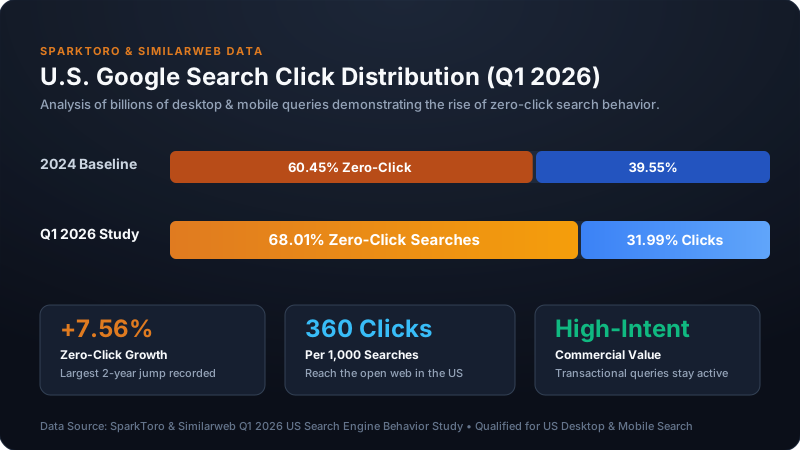
According to the Q1 2026 zero-click search study by SparkToro and Similarweb, 68.01% of all U.S. Google searches ended without an outbound click to the open web. That is up from 60.45% in 2024, reflecting an ongoing shift toward instant on-SERP resolution.
Industry tracking across tested commercial and informational query cohorts shows AI Overviews appearing on roughly 48 to 50 percent of tracked U.S. search results as of mid-2026 (though prevalence fluctuates widely by niche and query intent). When an AI Overview is present, independent research from Seer Interactive and agency data sets documented organic click-through rate drops between 30 and 60 percent on affected queries compared to traditional ten-blue-link layouts.
If your SEO strategy was built entirely around ranking for basic informational queries like "what is keyword research" and hoping for passive clicks, that specific segment of organic traffic has been fundamentally compressed.
“The 68.01% zero-click figure reflects U.S. desktop and mobile search behavior analyzed by SparkToro and Similarweb. AI Overview prevalence and CTR drops vary significantly across geographic regions and transactional vs. informational queries.”
- 68% of U.S. Google searches produce zero outbound clicks (SparkToro / Similarweb Q1 2026).
- AI Overviews appear on ~48-50% of tracked informational/commercial query sets in the U.S.
- Organic CTR drops 30% to 60% on specific queries where AI Overviews displace top organic positions.
- High-intent commercial queries and local searches remain significantly more resilient.
2. What Is Actually Dying vs. What Still Works
The honest reality is that SEO is not dead, but legacy tactical playbooks are losing effectiveness rapidly. During my training and hands-on projects, the clearest pattern was the widening gap between traditional keyword-repetition methods and modern entity-driven search.
Thin informational content that merely summarizes what Google can synthesize in an AI snippet is losing its traffic value. Mechanical link building through low-tier directory submissions and generic guest posts provides diminishing returns. Keyword density optimization is increasingly obsolete because modern search models understand topical context and conversational intent.
What continues to work is durable: technical SEO foundations like crawl efficiency, structured semantic data, internal link hierarchy, and Core Web Vitals remain non-negotiable. High-intent commercial and decision-stage pages continue to capture engaged traffic because buyers require deep comparisons, pricing transparency, and verifiable proof before converting.
Content demonstrating genuine first-hand experience, proprietary testing, and verifiable author expertise holds sustained value because it provides authentic information that language models cannot synthesize from generic summaries.
“Search fundamentals—crawlability, structured data, and internal linking—have not been replaced. What has changed is the requirement for genuine first-hand expertise and verifiable entity signals on top of those foundations.”
- Thin informational summaries and mechanical link building are rapidly losing ROI.
- Technical SEO, clean crawl architectures, and fast performance remain foundational.
- High-intent commercial and comparison content continues to drive valuable organic conversions.
- Demonstrable first-hand experience and original testing cannot be replicated by AI synthesis.
3. GEO: Getting Cited by AI, Not Just Ranked by Google
Generative Engine Optimization (GEO) is an emerging framework focused on structuring and presenting content so that AI-powered search engines—such as Google AI Overviews, Perplexity, and ChatGPT Search—can accurately retrieve, synthesize, and cite your brand as an authoritative source.
While traditional SEO aims to secure positions in organic result rankings, GEO strategies aim for inclusion within generative answer summaries. Language models evaluate clarity of factual statements, unambiguous entity definitions, answer-first formatting, and citation authority across external references.
During my hands-on experiments implementing Schema.org entity graphs and public /llms.txt markdown endpoints, I observed how clear structural hierarchies and concise definition blocks facilitate automated parsing by LLMs. However, it is essential to understand that /llms.txt is an emerging community standard for LLM ingestion, not an official Google ranking requirement.
An honest word on measurement: GEO tooling is still in its early stages in 2026. While practitioners track visibility via metrics like "AI Share of Voice" or citation frequency across prompt tests, standardized analytics do not yet exist. Treat GEO as an evolving content architecture discipline rather than a settled formula.
- GEO is an emerging optimization framework designed for generative AI retrieval and citations.
- Answer-first architecture, concise definitions, and structured tables improve AI retrievability.
- /llms.txt serves as a helpful community convention for markdown consumption, not an official Google requirement.
- Measurement tooling for AI search citations remains experimental—be cautious of rigid GEO scoring claims.
4. Entity Authority and Why Brand Signals Matter Now
Modern search systems increasingly assess websites not as isolated domains, but as interconnected entities within a broader Knowledge Graph. While E-E-A-T (Experience, Expertise, Authoritativeness, Trustworthiness) is not a direct algorithmic score, Google uses numerous machine-learning signals and search quality guidelines to evaluate whether an entity is credible and trustworthy.
In practical terms, "brand signals" represent verified external consensus. Search engines and AI systems validate organizations and individuals through corroborating third-party sources: verified professional profiles, active industry citations, customer reviews, accredited credentials, and consistent semantic markup across the web. Without verifiable external consensus, establishing topical authority in competitive queries becomes significantly harder.
Furthermore, user discovery has fragmented across multiple specialized platforms. Reddit has become a trusted hub for authentic, peer-verified advice. YouTube serves as the primary visual search engine for tutorials and product reviews. TikTok drives discovery among younger demographics. AI assistants frequently favor sources that demonstrate cross-platform presence and real-world consensus.
The strategic takeaway is clear: your digital authority footprint must extend beyond your own website to reinforce entity recognition across the broader web ecosystem.
“Brand signals reflect third-party consensus. Search engines and AI models corroborate your authority through external citations, professional verification, and consistent cross-platform presence.”
- Search engines evaluate topical authority through entity relationships and Knowledge Graph connections.
- E-E-A-T represents a holistic evaluation concept rather than a single numerical ranking factor.
- Cross-platform presence on platforms like YouTube, Reddit, and LinkedIn strengthens entity recognition.
- A unified entity footprint across the web provides durability against algorithmic fluctuations.
5. What to Actually Do About It: A 3-Tier Priority Framework
Rather than adopting fragmented tactics or chasing speculative AI trends, search visibility in 2026 requires a disciplined, multi-layered approach.
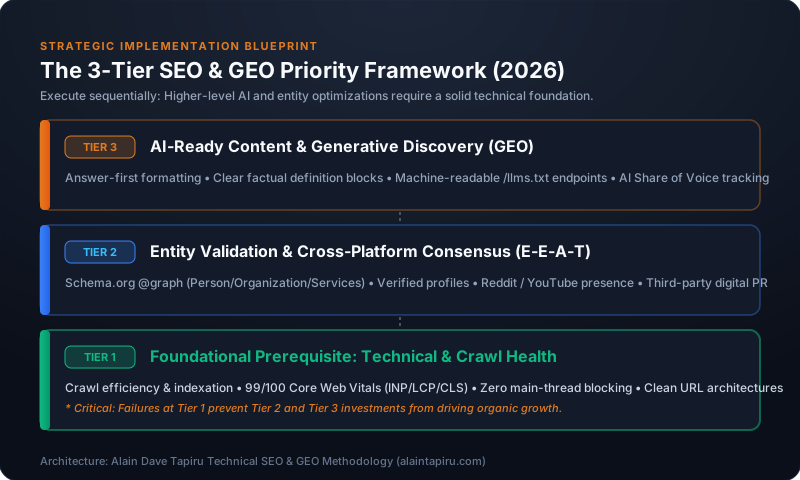
Tier 1: Technical & Crawl Foundation. Solidify crawl efficiency, structured JSON-LD schemas, Core Web Vitals, mobile usability, and clean site architecture. These foundational elements remain non-negotiable. If search engine crawlers encounter rendering bottlenecks, slow response times, or broken indexability, higher-level content optimizations cannot succeed.
Tier 2: Entity Validation & Brand Authority. Implement interconnected Schema.org graphs linking Person, Organization, and Service nodes. Maintain consistent profiles across reputable third-party platforms. Build topical depth through structured clusters and showcase verifiable credentials and original work.
Tier 3: AI-Ready Content & Generative Discovery. Format key content sections using direct answer blocks, structured tables, and explicit factual summaries. Maintain optional machine-readable /llms.txt endpoints to assist LLM retrieval, and monitor brand citations across emerging generative answer engines.
I structured my own digital portfolio around these exact principles: August 2026 PageSpeed screenshots recording 99 desktop and 96 mobile lab scores in my technical architecture case study, unified Schema.org @graph markup connecting author and services, answer-first blog sections, and an interactive 10-point Google Business Profile diagnostic tool. The screenshots are simulated lab evidence, not field Core Web Vitals. These steps prioritize documented technical work over speculative shortcuts.
- Tier 1: Technical accessibility and fast Core Web Vitals remain the foundational prerequisite.
- Tier 2: Entity validation via Schema graphs and external third-party consensus establishes authority.
- Tier 3: AI-ready formatting and machine-readable data facilitate generative search citations.
- Execute sequentially: foundational technical failures undermine all downstream efforts.
6. The Honest Answer
SEO is not dead. However, the legacy playbook centered strictly on keyword stuffing, generic informational content, and ranking position as the sole performance metric is obsolete.
Modern search has expanded into a holistic discipline encompassing technical web performance, entity validation, AI-friendly content architecture, and multi-channel brand presence. Organizations and practitioners that adapt to this broader discovery landscape will secure a durable competitive advantage.
The empirical data does not support the demise of search optimization. Rather, it underscores the transition toward higher quality standards, verifiable human expertise, and multi-surface search discovery.
Need Practical Help Implementing These Strategies?
From Core Web Vitals speed tuning to structured data implementation and local SEO diagnostics, let's build search-ready digital foundations.